Solder Paste Printing: The Parameters That Decide Half Your Yield
Most solder defects are decided before the board reaches the oven. Industry practice puts the share of defects originating in printing at roughly half to two thirds, depending on board mix — which is why a printing window is worth more attention than another AOI recipe.
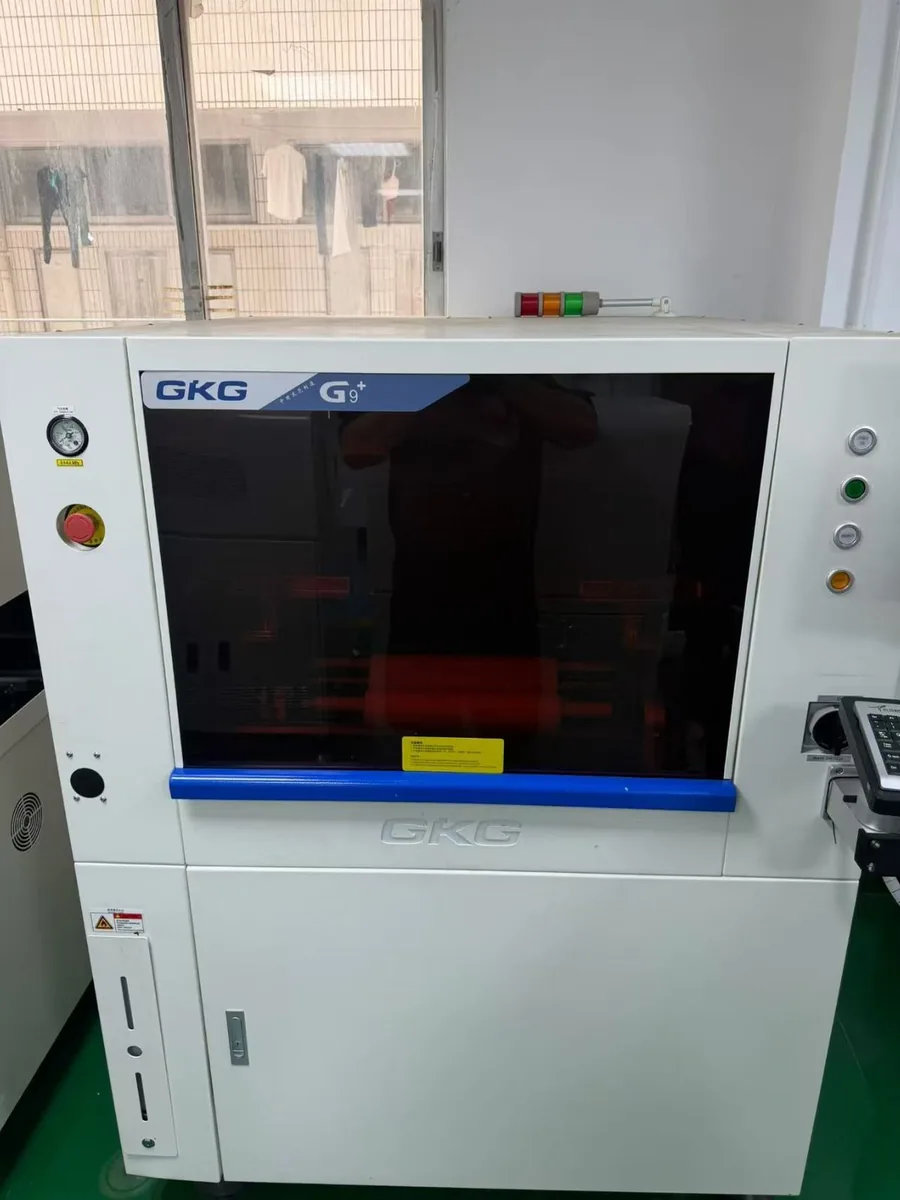
Solder paste printer: pressure, speed and separation speed are the three settings that decide paste volume
The four settings that matter most
Squeegee pressure. Start low and increase until the stencil surface is clean after the stroke, then stop. On a 300 mm blade this typically lands between 3 and 6 kg depending on blade type and paste; expressed per unit length, roughly 0.01–0.02 kg/mm. More pressure does not improve fill — it wears the blade, pushes paste under the stencil and shortens stencil life.
Print speed. 20–80 mm/s is the usual range; fine-pitch and 0201 work sits at the low end (20–40 mm/s) because the paste needs time to roll and fill small apertures. Fast strokes leave voids in the deposit, which show up as insufficient paste on small pads and as voids after reflow.
Separation speed. The stencil must peel away from the paste, not lift it. 1–3 mm/s is common, slower for fine pitch and for large apertures. Fast separation is a classic cause of "dog-ear" deposits and of paste pulled to one side of the aperture.
Wipe interval. A dry wipe every 3–5 prints and a solvent wipe at a longer interval (with vacuum assistance) keeps the underside clean. Paste on the underside is transferred to the next board and appears as beading or bridging that moves between panels.
Environment and paste handling
Printing is a rheology process, so temperature and humidity are process parameters: 23 ± 3 °C and 40–60% RH. Paste should be warmed to room temperature before opening (about two hours), stirred only as the maker specifies, and used within its open time — typically four to eight hours. Paste that has been open longer thickens, releases poorly and slumps, and no printer setting fully compensates.
Never top up a used deposit with fresh paste. Mixing changes viscosity in a way that varies through the shift, which is exactly the kind of drift SPI will show but nobody can explain.
What 3D SPI should be telling you
In-line 3D SPI at 100% is the only way to know what the stencil delivered. Four measurements matter: height, volume, area and offset. Practical acceptance is usually height within ±20% of foil thickness, volume within 80–120% of the aperture's theoretical volume, and area within 80–120% of aperture area, with CpK at or above 1.33 on volume for a stable process.
Read SPI as a trend, not a pass/fail gate. Volume drifting down across a shift points at paste condition or wipe; volume high on one region points at pressure or support; offset in one direction points at alignment or stencil registration.
Matching defect signatures to settings
- Insufficient paste on small apertures only — clogging, poor release, wall roughness, or speed too high;
- Insufficient paste everywhere — pressure too low, paste too viscous, open time exceeded;
- Excess paste with smearing at aperture edges — pressure too high or separation too fast;
- Skipped deposits in a line — stencil damage, support gap or a blade nick;
- Volume varies with panel position — support, clamping or panel warp.
Why this stage deserves the attention
A reflow profile can be tuned in an afternoon; a printing window takes discipline every shift. But the oven can only work with the paste it receives: voids, insufficient joints, tombstones and bridging all begin as a deposit that was 20% off. Fixing printing raises first-pass yield across every defect category at once, which is a better return than chasing each defect separately at the inspection stations.
For a dense board — 0201, 0.4 mm pitch, mixed thermal mass — ask a supplier for their SPI CpK on volume and their wipe schedule. The numbers answer the quality question more honestly than a certificate does.